



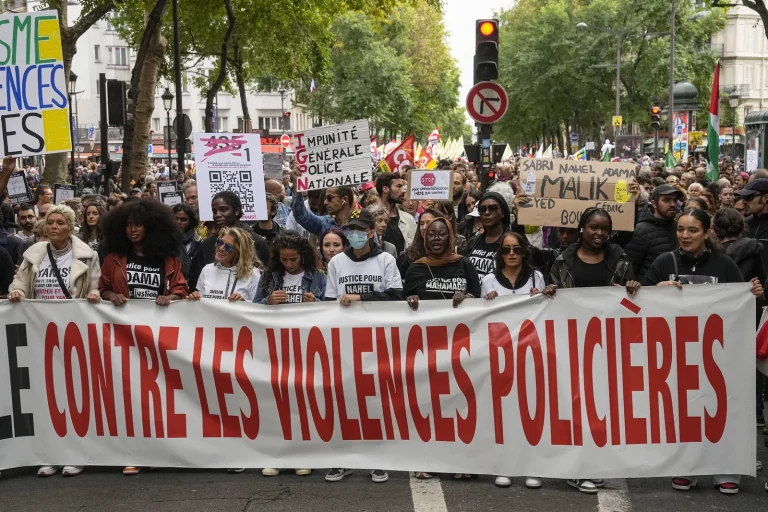
A 12-year-old girl riddled with bullets. Thousands of documented racist offenses. Black people and people of North African descent regularly facing discrimination. Behind France’s image as a champion of human rights lies a painful reality. Cameroun Liberty examines official statistics, testimonies, and recent events. One question demands an answer: How many more victims will it take before fighting racism becomes a genuine national priority?
A 12-Year-Old Girl: The Unbearable Face of Racial Hatred
Paris, November 12, 2026. On October 23, France was shaken by an appalling act of violence.
In Trappes and La Verrière, in the Yvelines department near Paris, a gunman opened fire on several people. The attack left one person dead and five injured.
Among the victims was a Black girl, just 12 years old, who suffered multiple gunshot wounds.
According to reporting by Le Monde, the child sustained serious injuries to her liver, kidney, arms, and legs. She was rushed to Necker Hospital in Paris.
The suspect reportedly admitted selecting victims based on their perceived ethnicity or religion, according to investigative details reported by the press. France’s national counterterrorism prosecutors took over the case, which includes allegations of racist or anti-religious motivation.
The investigation must still establish the full extent of criminal responsibility.
But one reality remains: a 12-year-old girl was targeted in an attack in which racist motives are central to the investigation.
How does a society reach this point?
And, more importantly, how can we prevent other children from becoming victims of hatred they did nothing to provoke?
Racism in France: Numbers That Cannot Be Dismissed
It would be easy to claim that such violence consists of isolated incidents.
Official data tells a far more disturbing story.
According to the 2025 report of France’s National Consultative Commission on Human Rights (CNCDH), published in June 2026, 9,737 racist, xenophobic, or anti-religious crimes and serious offenses were recorded in France in 2025.
That represents a 5% increase compared with 2024.
When lesser offenses are included, France’s Ministry of the Interior recorded more than 16,400 offenses of this nature during the same year.
Even more troubling, the CNCDH emphasizes that the overwhelming majority of victims never file a police report.
Behind every statistic is a person. A family. An act of humiliation. Sometimes, a life shattered.
Racism is not an illusion. It is not something immigrants have invented. It is a reality documented by France’s own institutions.
Being Black in France: Having to Constantly Prove You Belong?
For many Black people, discrimination extends far beyond being insulted in the street.
It can emerge during a job search, when seeking housing, through interactions with certain institutions, or during police identity checks.
France’s Defender of Rights, an independent public authority, acknowledges the scale of these inequalities.
In its report on discrimination based on origin, the institution highlights how young men perceived as Black or Arab are particularly exposed to police stops.
A study cited by the institution found that, all other factors being equal, certain categories of young men perceived as Black or North African faced a likelihood of being stopped by police up to twenty times higher than others.
These findings do not mean that every police officer engages in discrimination. They do, however, reveal inequalities serious enough to demand structural solutions.
The European Union Agency for Fundamental Rights has also documented persistent racism against people of African descent across several European countries, including France.
Why should someone’s skin color change the way they are viewed, stopped, hired, or treated with respect?
Immigration and Crime: When Foreigners Become Convenient Scapegoats
In French political debates, immigration and public safety are frequently linked.
On social media, some comments almost automatically blame Black people, Arabs, or immigrants whenever an act of violence makes the news.
Yet criminal responsibility is individual.
A person who commits a crime must be judged for their actions, regardless of their background.
During riots, acts of vandalism, or collective violence, those involved may come from very different backgrounds. Blaming an entire community would be irresponsible.
White people can commit crimes, just as Black people, Arabs, and members of other groups can.
Ethnic background is not evidence of guilt.
Why, then, do some political and public narratives appear to demand more explanations from people with immigrant backgrounds than from other citizens?
That difference in treatment, whether documented or perceived, deserves serious examination in any democracy.
Marine Le Pen, the Far Right, and the Responsibility of Political Rhetoric
The electoral rise of France’s National Rally has profoundly shaped the country’s political landscape.
In 2022, Marine Le Pen received 41.45% of the votes cast in the second round of the French presidential election.
In 2024, the National Rally once again demonstrated its electoral strength during parliamentary elections.
These results illustrate the importance of issues promoted by this political movement among a significant portion of the electorate.
However, voting for Marine Le Pen does not automatically mean holding racist beliefs. Voters’ motivations are diverse.
Nevertheless, it remains legitimate to question the consequences of political rhetoric that portrays immigration as a threat to national security, identity, or social cohesion.
In its report published in June 2026, the CNCDH found that 44% of respondents considered immigration the main cause of insecurity.
That opinion deserves scrutiny, factual examination, and public debate.
A democracy cannot accept millions of people being treated as suspects simply because of their origins.
Violence, Assault, and False Accusations: Human Dignity Has No Color
For some victims, racism is accompanied by physical violence, humiliation, sexual assault, or accusations they maintain are unfounded.
Others report being treated differently in judicial or administrative proceedings.
These situations do not necessarily arise from the same causes and must be examined on the basis of available evidence.
But when someone says they have experienced racist violence, their account deserves to be heard, and the allegations should be investigated seriously.
No one should be assaulted, humiliated, burned, raped, or falsely accused because of their skin color.
And when an assault is established, the victim’s background should never influence how seriously the justice system responds.
For years, the CNCDH has raised concerns about shortcomings in the criminal justice response to racist offenses and discrimination.
Justice can only be credible when it protects victims without creating a hierarchy based on ethnicity, religion, or skin color.
From Africa, We Are Watching France Too
In Cameroon, events in France are followed with particular attention.
The historical, cultural, economic, and family ties between France and Africa make these issues deeply significant.
Thousands of African families have loved ones who live, study, or work in France.
When these individuals describe humiliation or discrimination, their experiences should not be automatically dismissed.
France has played a central role in promoting the ideals of liberty, equality, and fraternity.
But those principles cannot remain mere words engraved on public buildings.
They must apply to everyone.
To the Black woman looking for a job.
To the African student hoping to build a future.
To the young French citizen of North African descent who refuses to be treated as a foreigner in his own country.
And to the 12-year-old girl whose life was forever changed by gunfire.
Are White People Afraid of Losing Their Power?
Perhaps the question should be asked differently: To what extent are certain racist narratives driven by fear of losing privilege or a position of dominance?
Racism can emerge from prejudice, power imbalances, historical legacies, and deeply rooted social attitudes.
That does not mean all White French people share these behaviors.
Many French citizens, journalists, nonprofit organizations, and members of the judiciary work every day to combat discrimination and defend victims.
But acknowledging their efforts must never become an excuse to minimize violence or conceal persistent injustice.
Equality does not take rights away from White people.
It simply guarantees that Black people have the same rights, dignity, and opportunities.
Respect for Black people is not a favor to be granted. It is a fundamental human right.
Cameroun Liberty: We Refuse to Let These Stories Be Forgotten
The October 23, 2026, attack is a devastating reminder that racism can destroy lives.
Official figures demonstrate that racist violence and discrimination extend far beyond a handful of widely reported incidents.
Behind the statistics are children, parents, workers, students, and families whose stories deserve to be told.
Cameroun Liberty intends to continue its journalistic coverage of discrimination, racist violence, and the responses of French authorities.
We will examine facts, court decisions, testimonies, and public policies.
Without turning suspicions into convictions. Without blaming an entire population for the actions of a few individuals. But above all, without erasing the suffering of victims.
A republic that proclaims equality must have the courage to confront its own injustices.
And as long as people can be humiliated, assaulted, or discriminated against because they are Black, one question will continue to echo:
How many more lives must be shattered before skin color stops being a source of danger?

